


When several luminaires illuminate the same wall or ceiling, their colour consistency becomes part of the finished design. Specifying the same colour temperature is a useful starting point, but it does not fully define how closely the light sources match.
For hotel interiors, retail displays and architectural lighting, review colour temperature, colour rendering and colour consistency together. Each describes a different aspect of the light.
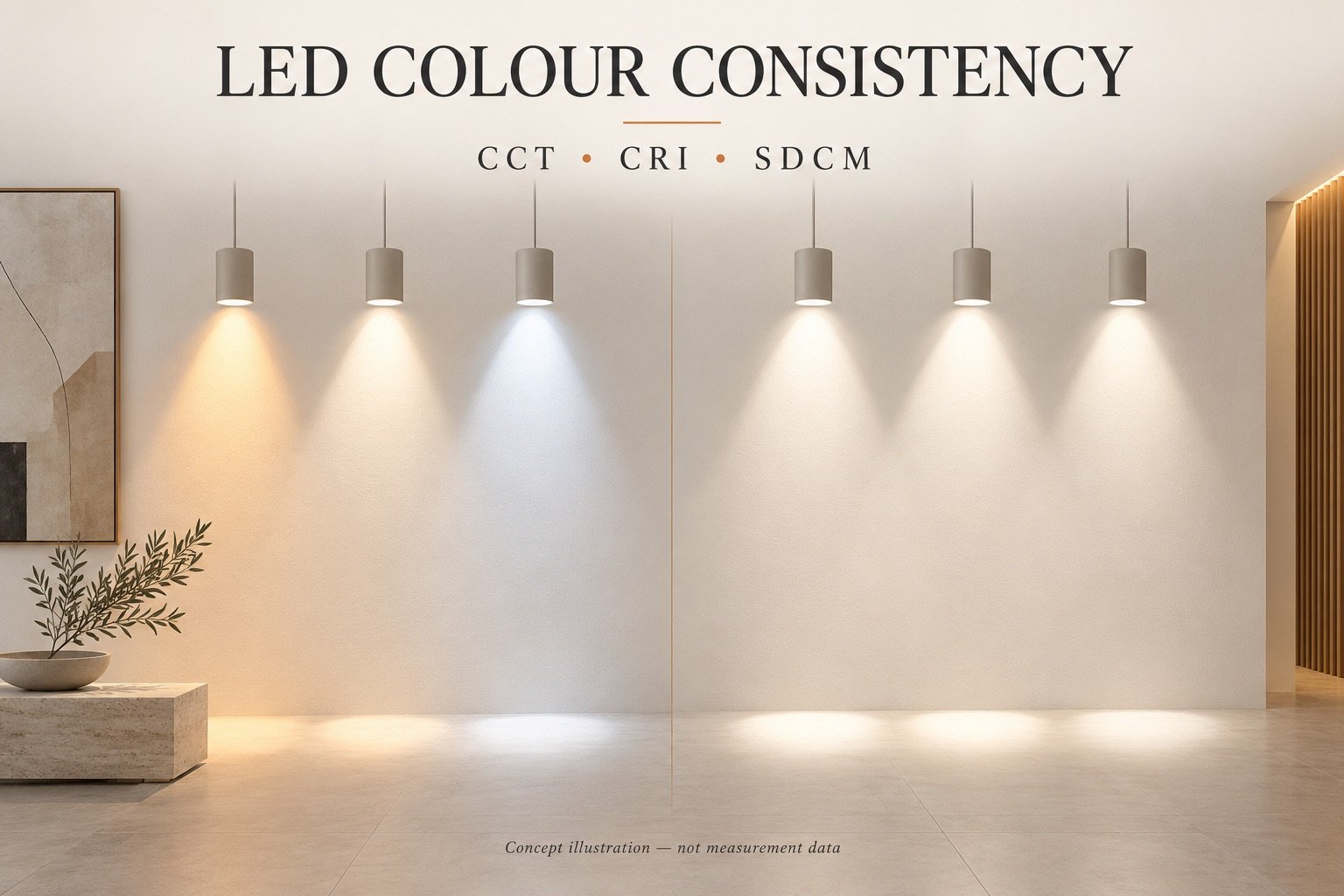
CCT, CRI and SDCM: Three Different Checks
| Parameter | What it describes | What to confirm |
|---|---|---|
| CCT | The warm or cool appearance of white light, expressed in kelvin. | The specified colour temperature for each zone. |
| CRI | How a source renders object colours relative to a reference. | The colour-rendering requirement for the application. |
| SDCM | Colour consistency described using MacAdam ellipses. | The tolerance applicable to the selected model and configuration. |
A smaller SDCM step value indicates a tighter colour tolerance. Two products can share a nominal CCT and CRI while having different colour-consistency specifications. Check all three rather than treating one as a substitute for the others.
Where Colour Matching Deserves Particular Attention
Consider the visual relationship between luminaires, surfaces and viewing positions. Adjacent light sources, repeated ceiling patterns and fittings illuminating a continuous pale surface are useful locations for a sample comparison.
In hospitality projects, review the lighting together across connected spaces. For retail, assess the merchandise under the proposed lighting as well as the appearance of the luminaires themselves.
For a 360° LED tube layout, compare representative illuminated sections and the proposed arrangement. For acoustic lighting, evaluate the light output alongside the acoustic element’s material and finish. Acoustic performance requires separate evidence; it cannot be established from lighting specifications.
Original Bridgelux or Cree LEDs: Confirm the Complete Configuration
KLM Lighting commonly uses original Bridgelux or Cree LED light sources, depending on the product and specified configuration. Confirm the LED brand and applicable option for the model in your lighting schedule.
The LED brand is one part of the selection. It does not, by itself, establish the SDCM, CRI, CCT or complete-luminaire performance of every product. Review the corresponding specification and available evidence for the exact configuration.
Record the model, LED brand or option, target CCT, CRI, required SDCM and driver/control combination together. Confirm any missing values before final selection.
Confirm What the Colour Specification Covers
Ask whether the colour-consistency statement describes the LED component, module or complete luminaire, and whether it is an initial specification or includes a defined colour-maintenance claim.
Do not assume that a value for one product also covers every downlight, track light, decorative tube or acoustic pendant in the schedule. For tunable-white products, ask how colour consistency is specified across the operating range.
Turn the Requirement into a Reviewable Lighting Schedule
Before requesting a quotation, give each proposed configuration its own schedule row. A product-family name alone may not identify the LED option, CCT, diffuser, optics or control arrangement being offered. Keep the requested requirement separate from the supplier’s confirmed value so that an unanswered question cannot become an assumed specification.
| Schedule field | What the buyer records | What needs confirmation |
|---|---|---|
| Product and configuration | Model reference, mounting and optical or diffuser option | The exact configuration covered by the supplied document |
| White-light requirement | Target CCT, required CRI and SDCM if specified | Documented values for that configuration, not a family-wide assumption |
| Evidence scope | Document reference and revision | LED component, module or complete luminaire; initial or maintained performance |
| Controls and sample | Proposed driver, control method and sample reference | Which operating conditions were reviewed |
| Approval status | Accepted, pending clarification or revised | Who approves the requirement and which open points remain |
This is a suggested procurement record, not a claim that every KLM product already has a particular test report. If evidence is missing, mark the field pending and ask for clarification before approving the configuration.
Review Representative Samples in a Defined Sequence
Start with the fittings that will be seen together. For example, a continuous tube feature and adjacent acoustic pendants may need to be reviewed as a visual combination rather than as two isolated samples. This does not mean their construction, light output or acoustic properties are interchangeable.
- Identify the sample. Record the model, CCT, LED option where specified, optics or diffuser, and driver/control combination. Confirm whether it represents the configuration proposed for supply.
- Set up a relevant comparison. Use representative finishes, spacing and viewing positions where practical. Compare both the illuminated surfaces and the visible light sources.
- Record the operating condition. Note the settings used for the review. For dimmable or tunable-white products, agree which settings matter to the project rather than assuming a single photograph covers the operating range.
- Separate appearance from measurement. Record visual observations and any applicable measurement evidence separately. Camera exposure and white balance can change apparent colour; a photograph is not an SDCM measurement.
- Close the open points. Keep unresolved values visible, identify what document or sample review is needed, and record the approved configuration before procurement.
Agree the review procedure with the project team and supplier. These steps are selection guidance, not a substitute for a project specification or a promise of a universal acceptance threshold.
Plan for Phased Orders and Replacements
Keep a record of the approved model, configuration, sample and documented colour requirement. For phased procurement or future replacements, ask the supplier to review matching requirements before ordering.
An initial SDCM specification alone does not establish a guarantee that a later replacement will visually match an aged installation. Confirm the applicable conditions and supporting colour-maintenance information separately.
What to Include in Your Project Enquiry
- Application and lighting schedule.
- Models, quantities and procurement phases.
- Target CCT, CRI and required SDCM where specified.
- LED brand preference and driver/control requirements.
- Locations where different fittings will be viewed together.
- Sample approval and measurement-document requirements.
Review Your Lighting Schedule with KLM
Share your project requirements so that the applicable model specifications and outstanding technical details can be reviewed before selection.
Technical reading: ERCO: colour consistency (SDCM); Philips: Fortimo LED Linear design-in guide. These explain general principles; KLM product values must be confirmed separately.
